


What is paragraph dyeing? how to dye it?
Jun 21, 2022
Leave a message
What is segment dyeing
Space dyeing refers to dyeing two or more different colors on a twisted yarn or fabric. Segment dyeing products are novel and unique, and the style of fabrics woven by segment dyed yarns has achieved a fundamental breakthrough, so it is favored by consumers.
Yarns suitable for segment dyeing include: cotton, polyester cotton, acrylic cotton, viscose staple filament, acrylic, rayon, polyester yarn, pure plush yarn, nylon yarn, nylon staple filament and various blended yarns , The dyes that can be used for segment dyeing are: reactive dyes, acid dyes, disperse dyes, coatings, etc.
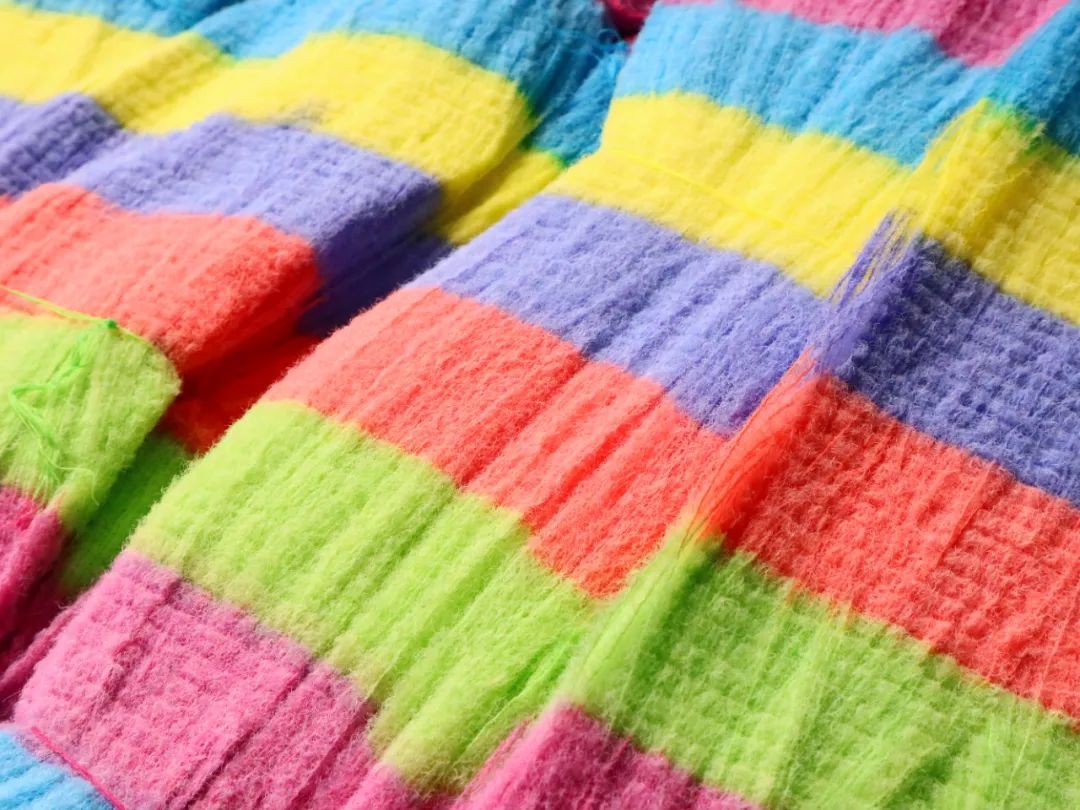
Segment dyeing method
The method of segment dyeing can be mechanical segment dyeing or original manual segment dyeing. Mechanical segment dyeing can be divided into direct segment dyeing and indirect segment dyeing.
There are also a lot of equipment for mechanical section dyeing. Some equipment can dye up to six colors at a time, which is integrated with dyeing and color fixing. There are more and more people studying the technology of section dyeing, and the mechanical materials, auxiliaries and processes of section dyeing are also constantly developing.
For a long time, yarn-dyed fabrics are made by first dyeing the yarns, and then arranging the yarns according to the designed pattern for weaving. The woven fabrics are neat and regular. Since each yarn has only one color from the beginning to the end, the style of the woven fabrics is monotonous and unremarkable. The yarn-dyed product made of six-color space-dyed yarn is named as the colorful yarn fabric.
1. Pure cotton
CJ14.6/14.6 472/314.5 (CJ5.8×2+CJ11.7)/(CJ5.8×2+CJ11.7) 629.5/354
2. Polyester cotton
T/CJ7.3×2/13 464.5/307 T/CJ13/13 472/314.5
3. Low proportion polyester and cotton blended (CVC) CJ/T7.3×2/7.3×2 456.5/314.5
Technological process: warp and weft: cheese yarn → twisting → boiling yarn → dyeing → winding warp yarn: warping → sizing → harness reed} → weaving → blank inspection → singeing → washing → (mercerizing) → soft setting → Preshrunk
Technological process: warp and weft: cheese yarn → twisting → boiling yarn → dyeing → winding warp yarn: warping → sizing → harness reed} → weaving → blank inspection → singeing → washing → (mercerizing) → soft setting → Preshrunk
Weft yarn: --- This kind of colorful yarn is a new breakthrough in yarn-dyed fabrics, and there will be greater breakthroughs in researching and designing fabrics with space-dyed yarns.
direct segment dyeing
Before the skein of the skein is desizing, scouring, bleaching and other pre-treatments, the amount of alkali should be paid attention to. Too much will easily reduce the strength of the yarn. surface quality. The wool effect of the scouring yarn is not less than 8cm/30min, and the pH is 7-8. If the wool effect is too low, it will affect the penetration of the color paste and cause poor dyeing.
1. Dope dyeing of cotton yarn
The paint section has complete dyeing spectrum, convenient color matching, stable color and light, not easy to permeate, clear outline, simple process, and the disadvantage is that it feels hard.
1.1 Technological process: After scouring, the scouring and printing section of the yarn is dyed and sizing and then steamed (100-102℃, 5-10min)—washing—drying—sizing
1.2 Process points: Adhesives: Use cross-linking adhesives, such as screen printing adhesives, with good film-forming feel, high brushing fastness, and no yellowing at high temperature. The dosage should be determined according to the concentration of the paint in the color paste. High, if the dosage is too small, the fastness is poor;
Emulsified paste: oil-water type emulsion paste is used;
Coating: The particle size is between 0.2-0.5um. If it is too large, the covering power will be poor, the wear resistance will be poor, the color tone will be dull, and the color will be reddish; if it is too fine, the brightness will be reduced, the color supply will be reduced, and the paint color paste will be easy produce agglomeration;
Urea: Add urea to the color paste, the color paste becomes thinner, the viscosity decreases, the color paste is more stable, and it is not easy to form a film, and the amount is as small as possible, otherwise the fastness will be reduced, and the edge of the dyeing will be seriously infiltrated during steaming;
Cross-linking agent: Adding cross-linking agent can improve abrasion resistance and scrubbing fastness, but the amount should be strictly controlled, and too much will affect the hand feeling. The method of segment dyeing is similar to that of fabric printing.
1.3 Points to note in the process: In order to prevent the dyeing part from infiltrating, the dye is formulated into a color paste, which is spray-printed on the yarn through the dyeing machine. The temperature during drying is not easy to be too high, and the yarn should be 80% dry when leaving the drying room. The paint segment dyeing process is simple and the utilization rate of dyes is also high, which is also a good segment dyeing method.
2. Reactive dyestuffs of cotton yarns
The reactive dyes have complete chromatogram and excellent dyeing fastness. The dyeing of pure cotton yarn mainly uses KE reactive dyes. However, it is found in production that if KE is used for segment dyeing, the washed dyes are easily contaminated, resulting in fast dyeing. This may be because the KE type is a dual reactive base type, and the reactivity is higher than that of the K type. Unreacted dyes and hydrolyzed dyes are easily stained when washed with water. For this reason, K type dyes for printing are used, which are reasonably priced and easy to use. Satisfactory fastness can be obtained.
2.1 Process flow
The scouring yarn is dyed and sizing in the jet printing section and then steamed (100-102℃, 5-10min)-washing-drying-sizing.
2.2 The main points of the process are as follows:
When steaming, wrap the yarn with dry cloth to prevent seepage; choose medium-viscosity seaweed pulp, which is conducive to the color paste sprayed from the nozzle and penetrated into the lower layer of yarn, and 0.25%-0.5% of Sodium hexametaphosphate to prevent the influence of calcium ions, at the same time adjust pH=7-8 with soda ash, the whole paste requires no agglomeration; urea plays the role of wetting and solubilization, because the yarn is directly sprayed on the dyed size without drying. For steaming, when the amount of urea is large, it will cause serious infiltration. When it is dark, it can be added appropriately, and it can be omitted for medium and light colors. Baking soda is used as an alkali release agent, and the temperature of the paste should be lowered to room temperature before adding it. Otherwise, a large number of air bubbles will be generated in the color paste, and the stability of the color paste will decrease, which will affect the color supply and color fastness; the dye dissolution temperature does not exceed 90 °C, and the dye fastness of the reactive dye section is good and the hand feel is also good. Dye is used more.
2.3 Specific examples of segment dyeing process:
Type B reactive dyes direct segment dyeing process. The orange segment dyeing process draws on the fabric printing method. In order to make the segment dyed part impermeable, the dye is formulated into a color paste, printed on the skein by the method of pad printing, and then the dye is fixed by appropriate post-treatment.
(1) Process flow:
Rolling section → drying and color fixing (115℃, 1.5h) → post-treatment [detergent 1% (owf); 100℃, 5-10min].
(2) Process recipe of segment dye original paste:
Sodium Hexametaphosphate 6 g/L
Soda ash 4 g/L
Sodium alginate 48 g/L
Process conditions: gelatinization temperature 60~70 ℃;
time 3 hours
PH value 7~8
Orange segment dyeing paste process prescription:
Reactive Yellow B - 3RD 3.6 g/L
Reactive Red B - 4BD 0.52 g/L
Reactive Blue B - GD 0.012 g/L
Urea 50 g/L
Baking soda 15 g/L
Original paste 200 mL
2.4 Stage dyeing process parameters:
Color section length 3 cm
Padding times 8 times
Bottom center distance 16 cm
Note: In the whole process of knuckles, drying and color fixing is the key. The yarn after knuckle-rolling must be dried, otherwise the post-processing process will cause color matching and staining, resulting in secondary yarns.