


Why Knitted Fabric Always Has Horizontal Stripes, Why Is This Happening?
Mar 21, 2022
Leave a message
The knitted fabric always has horizontal stripes, why is this happening?
The horizontal bar is a common weaving defect caused by factors such as poor machine adjustment and raw material quality in the production process of the circular knitting machine. Generally, there are two types of hidden horizontal bars and monofilament horizontal bars. In the following, through the introduction of the characteristics of the circular knitted fabric, the reasons for its occurrence are analyzed from the aspects of raw materials, mechanisms, machine parts and adjustment processes, and corresponding preventive and rectification measures are put forward.
Causes of hidden horizontal stripes and preventive and corrective measures
Hidden horizontal stripes refer to the phenomenon that the size of the coil changes periodically during a cycle of machine operation, resulting in sparseness and unevenness on the cloth surface. Generally speaking, it is less likely that the raw materials will cause hidden horizontal strips, mostly due to periodic uneven tension caused by untimely adjustment after mechanical wear, resulting in hidden horizontal strips.
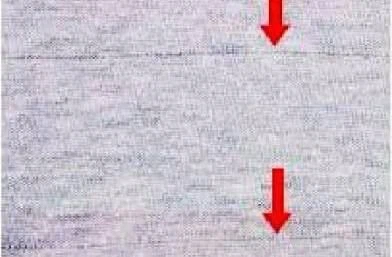
1.1 Causes
a. Due to low installation accuracy or serious wear and tear due to equipment aging, the levelness and concentricity deviation of the cylinder of the circular knitting machine exceeds the allowable tolerance. The common problem is that the gap between the positioning pin of the large gear plate of the transmission and the positioning groove of the machine frame is too large, which causes the needle cylinder to be unstable during operation, which seriously affects the yarn feeding and loop withdrawal.
In addition, due to equipment aging and mechanical wear, the main drive gear plate is swayed in the longitudinal and radial directions, which increases the concentricity of the needle cylinder and causes deviations in the concentricity of the needle cylinder. .
b. In the production process, the speed change disc adjustment slider of the yarn feeding mechanism is embedded with foreign objects such as flying flowers, so that the roundness is affected, the speed of the synchronous toothed belt is abnormal, and the yarn feeding amount is unstable, which leads to the occurrence of hidden horizontal stripes. .
c. The circular knitting machine adopts a passive yarn feeding mechanism, which is difficult to overcome the disadvantage of the large difference in yarn tension during the yarn feeding process, and it is easy to cause the unexpected elongation of the yarn and the difference in the yarn feeding amount, thereby forming a hidden horizontal stripe.
d. For the circular machine with intermittent coiling mechanism, the tension fluctuates greatly during the coiling process, and the length of the coil is prone to difference.
1.2 Preventive and corrective measures
a. The positioning surface of the gear plate should be properly thickened by plating, and the shaking of the gear plate should be controlled between 1 and 2 wires. Polish and polish the bottom ball track, add grease to flatten the bottom of the needle cylinder with a soft and thin elastomer, and strictly control the radial shaking of the needle cylinder at about 2 wires. The sinker triangle needs to be corrected regularly, so that the distance between the sinker triangle and the tail of the new sinker is controlled between 30 and 50 wires, and the position deviation of each sinker triangle should be controlled within the range of 5 wires as much as possible, so that the sinker is in retreat. Keep the yarn holding tension consistent when looping.
b. Control workshop temperature and humidity. Generally, the temperature is controlled at about 25°C and the relative humidity is controlled at 75% to prevent the adsorption of flying dust caused by static electricity. At the same time, necessary dust collection measures are taken to maintain cleanliness, strengthen machine maintenance, and ensure the operation of each rotating part. normal.
c. Transform the passive mechanism into a storage-sequence active yarn feeding mechanism to reduce the tension difference during the yarn guiding process. It is best to install a speed monitoring device to stabilize the yarn feeding tension.
d. Transform the intermittent coiling mechanism into a continuous coiling mechanism to ensure the continuity of the cloth curling process and the stability and uniformity of the coil tension.
Causes of monofilament horizontal stripes and preventive and corrective measures
The monofilament horizontal strip refers to the phenomenon that one or several courses of stitches on the surface of the fabric are too large or too small, and the density is uneven compared with other course stitches. In actual production, monofilament horizontal strips caused by raw materials are the most common.

2.1 Causes
a. The yarn quality is poor, and the monofilament has color difference, such as tight twisted yarn, chemical fiber filament without batch number, uncoated filament or mixed use of yarns of different yarn counts, which directly leads to the production of monofilament horizontal stripes.
b. There is a large difference in the size of the yarn bobbin or the forming of the silk cake itself has convex shoulders and slumps, resulting in uneven unwinding tension of the yarn, and it is easy to produce monofilament horizontal stripes. This is because the difference in the size of the bobbin will make the winding point and the diameter of the unwinding balloon different, and the change law of the antipyretic tension will inevitably have a large difference. In the knitting process, when the tension difference reaches the maximum value, it is easy to cause different yarn feeding amount, resulting in uneven coil size.
c. When using porous and ultra-fine denier raw materials for processing, the silk path should be as smooth as possible. A yarn guide hook is slightly rough or oily dirt is solidified. Compared with processing with conventional raw materials, it has more stringent requirements on equipment, and it is easier to produce monofilament horizontal strips into cloth.
d. The adjustment of the machine is not in place, and the pressure needle triangle is too deep or too shallow somewhere, so that the yarn tension is abnormal, and the size of the stitches formed is different.
2.2 Preventive and corrective measures
a. To ensure the quality of raw materials, use raw materials from famous brand manufacturers as much as possible, and have strict requirements on the dyeing of raw materials and the variation of physical indicators. The standard of dyeing requirements is above 4.0, and the coefficient of variation of physical indicators should be small.
b. The fixed weight silk cake is the best for processing. The fixed weight silk cake is selected and used on the machine with the same package diameter. It is found that the appearance is poor. If there is a convex shoulder and a sagging silk cake, it must be removed and used. When dyeing and finishing, it is best to follow the dyeing sample. If there are horizontal stripes, choose to change the non-sensitive color or add a horizontal strip treatment agent to eliminate or reduce the horizontal stripes.
c. When using porous and ultra-fine denier raw materials for processing, the appearance of the raw materials must be strictly checked first. In addition, it is best to clean the silk path and check whether each guide wire structure is smooth. During the production process, observe whether the weft feeder has tangled filaments. If found, stop immediately to find the cause.
d. Ensure that the depths of the pressure gauge triangles of each yarn feeding channel are consistent, and use the yarn length measuring instrument to finely adjust the bending position of each channel triangle to keep the yarn feeding amount consistent. In addition, check whether the yarn bending triangles are worn or not. The adjustment of the yarn bending triangles directly affects the size of the yarn feeding tension, and the yarn feeding tension directly affects the size of the loop formed.
in conclusion
1. In the production of circular knitted fabrics, the monofilament horizontal strips caused by the quality of the raw materials are the most common. The selection of raw materials with good appearance and good quality is very necessary for circular knitting production.
2. The daily maintenance of machinery is very important. The wear of some machine parts in long-term operation increases the deviation of the levelness and concentricity of the cylinder of the circular knitting machine, and it is very easy to cause horizontal bars.
3. In the production process, the adjustment of the needle pressing triangle and the sinker arc is not in place, which will cause abnormal loops, increase the difference in yarn feeding tension, and cause different yarn feeding amounts, resulting in horizontal stripes.
4. Due to the characteristics of the coil structure of circular knitted fabrics, the sensitivity of the horizontal stripes to the fabrics of different tissues is also different. Generally speaking, the probability of horizontal stripes appearing in single-area fabrics such as jersey is relatively high, and the requirements for machinery and raw materials are compared. high. In addition, the probability of horizontal stripes in the fabrics processed with porous and ultra-fine denier materials is also relatively high.